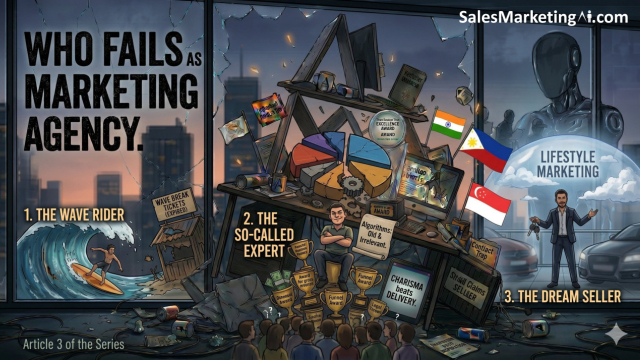
The first article asked when agencies collapse. The second asked how. This one asks something more specific, and perhaps more useful. Because understanding which type of agency is most likely to fail you might be the most important question a business owner asks before signing anything.
But not all agency failures look the same.
Some collapse loudly – unpaid freelancers, frozen accounts, bankruptcy filings that make the news. Others fade quietly, clients who churn without complaint, results that never quite materialised, promises that were never technically broken but somehow never kept.
And some never look like failure at all until we look closely.
Here’s three archetypes worth understanding. Not because they are the only ones, but because they are the most common. And the most consistently misread.
#1 The Wave Rider
When the market does the work, and the agency takes the credit.
Between 2020 and 2022, something extraordinary happened to digital marketing.
The world went online almost overnight. Businesses that had never run a digital ad were suddenly running campaigns. Consumers who had never shopped online were suddenly buying everything from their phones. Every marketing effort, however basic, seemed to produce results – because the market itself was moving with extraordinary momentum.
It was a tide. And it lifted every boat.
For some agencies, this was a defining moment. They grew fast, claimed big numbers, built impressive-sounding portfolios. Helped thousands of businesses. Generated millions in sales. Trusted by over X brands. The claims were not necessarily false. The results were real.
But here is the question nobody asked at the time:
Was it the agency or was it the tide?
Because when everyone’s campaigns are working, it is very easy to confuse being present with being skilled. The true test of capability isn’t what you achieve when conditions are favourable. It’s what you deliver when they aren’t.
“Anyone can sail fast when the wind is behind them. The question is what happens when it stops.”
By 2023 and beyond, the wind had shifted. Consumer behaviour normalised. Ad costs rose. Algorithms changed. The easy wins disappeared. And some of the agencies that had built their entire reputation on that extraordinary period suddenly found themselves unable to reproduce the results they had promised because the results were never entirely theirs to begin with.
But here is what makes this archetype particularly persistent: some wave riders never stopped. They simply found a new wave to narrate.
Years after the market moved on, you can still find courses teaching ebook businesses, dropshipping models, and Amazon FBA strategies, packaged with the same urgency as when they were genuinely cutting-edge. The Covid wave. The ecommerce arbitrage wave. The information product wave. The crypto and NFT wave. Different vehicles. Same pattern. The opportunity in the course is real. It just belongs to a different period.
“The most dangerous wave rider isn’t the one who got caught. It’s the one still selling tickets to a wave that already broke. The wave was real. Just that the timing expired.”
#2 The So-Called Expert
When the credential becomes the product
This archetype is subtler than the wave rider and in some ways more credible-looking on the surface.
The so-called expert has a real backstory. Early results that were genuine. A track record that once meant something. Certifications, partnerships, stage appearances, media features. On paper, the authority is there.
But somewhere along the way, a quiet pivot happened.
The doing gave way to the teaching. The client work gave way to the curriculum. The expertise that was earned through practice began to be recycled through programmes, masterclasses, and inner circles, without being continuously tested against current market conditions.
And markets change… Fast.
What worked in digital advertising three years ago may be entirely irrelevant today. The platforms evolved. The algorithms shifted. Consumer behaviour moved. An expert who stopped doing the work (even briefly) risks teaching yesterday’s playbook with today’s confidence.
The credentials compound the problem. Because credentials are designed to signal trust, and some are easier to acquire than they appear.
Some cost nothing but time. Others cost an entry fee submitted to an awarding body with no competitors in your category. And some of the most visually impressive revenue milestone awards tied to specific software platforms measure only the gross amount of money that passed through a funnel. Not profit. Not client results. Not business sustainability. Just a number, on a plaque, on a wall, in a pitch deck.
A million dollars in revenue means very little if it cost a million and two hundred thousand to make it. Seven-figure revenue with negative profit is not a success story. It is an expensive vanity metric dressed as one.
And when those screenshots get shared, sometimes with the inconvenient details conveniently blurred, the credential is no longer informing the client. It is performing for them.
The tell-tale signs are consistent:
- The advertising spend promoting their courses dwarfs any evidence of current client results
- The testimonials are overwhelmingly from course students, not marketing clients
- The claims are large and vague: “millions generated”, “thousands helped” without specific, verifiable, recent case studies
- Their social channels have accumulated large follower numbers but content averages a fraction of that in views – a community that followed but stopped learning or enjoying…
- When questioned publicly, the response is legal action rather than transparent evidence
That last point is particularly telling. A genuinely confident expert welcomes scrutiny. They show their work. They acknowledge limitations. They invite the conversation because they know the substance is there.
An expert hiding behind positioning does the opposite. They reach for lawyers instead of evidence. They call the questioner a bully, and in doing so, tell the market exactly what it needed to know.
Because here’s the truth about reputation in the digital age: you cannot sue your way out of a credibility gap. Legal action against a critic might silence one voice. But it amplifies a hundred others. A crowdfunding page that raises tens of thousands of dollars from over a thousand strangers in a short time is not just a legal fund. It is a public verdict.
“The question was never whether they made money. The question is whether their clients did.”
#3 The Dream Seller
When the lifestyle becomes the marketing
The dream seller is the most visually compelling of the three archetypes, and the easiest to mistake for success.
The product is no longer the campaign result or the course curriculum. It is the life. The luxury car in the thumbnail. The penthouse backdrop on the webinar. The lifestyle reel captioned “this is what financial freedom looks like.” The implicit, sometimes explicit, promise that what you are buying will eventually deliver not just skills or results, but this.
And here is the mechanism that makes it work so effectively: aspiration is a far more powerful motivator than information. Almost everyone scrolls past a pie chart but almost nobody scrolls past a penthouse.
So the marketing spend goes into the lifestyle content. The personal brand. The stage appearances at events where everyone looks successful and the energy is deliberately intoxicating. The testimonials that focus on transformation: “My life changed”, “I finally believed it was possible”, etc. rather than specific, measurable business outcomes.
The client who gets failed by this archetype is often the most motivated person in the room. The one who genuinely wants to change their circumstances. Who invested not just money but hope. Who walked away from the seminar genuinely inspired, only to realise months later that the inspiration hadn’t translated into anything bankable.
Because inspiration without infrastructure delivers no impact. And the infrastructure (the systems, the processes, the genuine operational support) was never really the product. The dream was.
“Charisma opens the door. Delivery is what keeps it open.”
There is one question worth asking before investing in any programme led by a dream seller:
If you removed the lifestyle content entirely… No cars, no houses, no revenue screenshots, no transformation stories, and looked only at the verifiable, specific, recent business results of their clients… would you still be interested?
If the answer is uncertain, that uncertainty is worth sitting with.
“When a guru’s lifestyle grows faster than their clients’ results, ask yourself a simple question: who is funding the upgrade?”
Engaging Marketing Agency Checklist
Before you trust the claim — read the signal
So who fails as a marketing agency?
Not the transparent one. Not the agency that shows its working, acknowledges its limitations, and lets its current client results speak louder than its past credentials. Not the one-person operation that is honest about its size but extraordinary in its output.
The agency that fails is the one that learned to perform capability more convincingly than it learned to deliver it.
Across all three archetypes, five signals are worth reading before you engage:
- Does their own digital presence reflect the quality they are promising you, or does it quietly contradict it?
- Is their community genuinely engaged, or just numerically large and silently disinterested?
- Are their results specific, verifiable, and recent, or large, vague, and suspiciously round-numbered?
- When challenged publicly, do they respond with evidence or with lawyers?
- Remove the lifestyle content entirely. Does the substance still stand on its own?
None of these questions are hostile. They are simply what separates an agency with genuine capability from one that has learned to perform it convincingly.
“The right agency welcomes the hard question. The wrong one makes you feel guilty for asking it.”
Final Thoughts
Three archetypes. One pattern.
Not every agency sets out to fail its clients. But some are structurally more likely to, not because of bad intentions, but because of what they have chosen to lead with.
Three archetypes. Three different entry points into the same disappointment:
The Wave Rider – still selling tickets to a wave that already broke.
The So-Called Expert – teaching what they no longer practice.
The Dream Seller – profiting from the aspiration before the client sees the reality.
Different presentations. Different price points. Different promises.
The same client, left wondering what happened to the results they were shown in the pitch.
Closing Note
This is the third article in an ongoing series exploring the patterns behind marketing agency failures, and what business owners can do to protect themselves. If you are navigating the world of marketing, sales, and AI, the conversation continues at SalesMarketingAi.com. Not with easy answers. But with honest ones.
“The loudest agency in the room is not always the best one for your business.”
The client who gets failed is never the one who asked too many questions.
It’s always the one who didn’t ask enough.